Showing posts with label cooking. Show all posts

Tuesday, September 13, 2011

Easy tasty fried Ikan Kembong / Mackerel


Fresh, inexpensive ikan kembong
For many reasons, ikan kembong (type of small mackerel), together with tenggiri (spanish mackerel) are my favorite choice of fish - they are easy to find and good for frying.  In contrary, I have problems finding fresh, good quality fish for steaming, which  keys to a good steamed fish.  But perhaps the biggest reason was that frying fish is relatively more forgiving then steaming a fish.

My favorite recipe for fish is fried fish with soy sauce mix.  This soy sauce mix is quite versatile and goes very well with any fried fish dish.

The preparation is simple: first fried the fish till golden brown/crispy; 2nd prepare the garnishing and 3rd make the soy sauce.

Garnishing
  • 2 inches of ginger - peeled and cut into thin strips intended for frying as a garnishing and to enhance flavor
  • 1 stalk spring onion - cut into 2-inch length think strips.  This is mainly used for ganishing.
Fried the ginger in a hot wok with 1 tbs of cooking oil till golden brown and set aside.  Use medium heat to avoid burning the ginger strips. Left the remaining oil in the wok for the soy sauce mix later.

Making the soy sauce mix
    • 1- 3 tablespoons soy sauce.  The amount of soy sauce forms the 'base' (together with the water) of the mix and how much to use does depends how much of the fish you have
    • 4 tablespoons water
    • 1 tablespoon Shaoxing wine (Chinese cooking wine)
    • 1-2 dashes white pepper powder
    • 1/4 teaspoon sesame oil - this is to enhance the fragrance of the dish, use sparingly.
    • 2 tablespoons sugar - this give a sweet-sour (from say sauce) taste
    There is not right of wrong mix ratio but generally soy sauce plays a dominant role here and it does detects the overall 'saltiness" of the mixture .  You can add more sugar if you like it to be sweeter, or add more pepper to have more kick/hot flavor. Shaoxing rice wine usually has a stronger taste and does tastes a little bit spicy if too much is used.  Feel free to experiment.

    Mix all the ingredients well. Pour the soy sauce mixture to the left over oil (from frying ginger strips earlier) until it boils (avoid using strong fire).  Then pour the say sauce over the fried fish.  Add the spring onion and fried ginger strips.

    Extra step
    Just like steamed fish, you could also fried some garlic with oil till golden brown, and then pour to the garnished fried fish which will instantly produce an appetite-hungry smell.

     Dinner is served.


    © copyright fiddling with recipe 2011

    Sunday, September 11, 2011

    Japanese Night - Teriyaki Pork Loin and Agadeshi


    These are first 2 Japanese dishes that I learnt and after a few tries, I am getting them just about right I think, thought I believed there are some 'tweaks" that can make them taste like an authentic Japanese dishes.

    As I found out, cooking Japanese dishes is not that difficult to begin with.  You don't have to re-stock your kitchen, you only need to stock up these three most basic ingredients :
    1. Hon Mirin - a sweet fortified liquor made from rice, used exclusively in Japanese cooking
    2. Soy source - Try get the Japanese soy sauce, rather than Chinese which have more salt and 'stronger'
    3. Cooking Sake/Ryorishu - similar to western white cooking wine but made with rice. It is used to marinades and made sauces.
      In addition to the above 3 essential ingredients. I also stocked bonito flakes (katsuo bushi) which I used to make dashi stock.  Bonito flakes is commonly used with tofu, balanced spinach, and so on.

      Both of the recipes were from Just One CookBook .  For detail and full recipe, just drop in.

      Here are some of the learning I gained from making these dishes.
      Agadeshi
      • The key is to dry/dehydrate the tofu sufficiently i.e the surface look dried.  This mean planned ahead. If the tofu is not sufficiently dried, the coating of the corn starch will become very messy and difficult to handle.  When I made it for the 1st time, I have to coat and re-coat the corn starch as it keep 'melt' away and the end-result was a tofu with thick corn starch casting that wasn't that good tasting.
      • My preferred way to dehydrate the tofu is to drain all the water and leave it in the refrigerator for 1-2 hours.
      • Full recipe is here
      Teriyaki Pork Loin
      • Honestly, I still have not achieve the soft and tender type of pork that I am looking for.  I am still looking ways to make the pork loin softer to chew with.  What I have done so far is  to hit and flattens the meat before frying it.  I reckon rubbing it with corn starch may help tenderize the meat further, which I am going to try next time.
      • Overall, this is a very satisfying and appealing dish - it got the protein and vege.
      • Full recipe is here
      Give these 2 dishes a try.  They are much easy then you think.

      © copyright fiddling with recipe 2011

      Friday, August 19, 2011

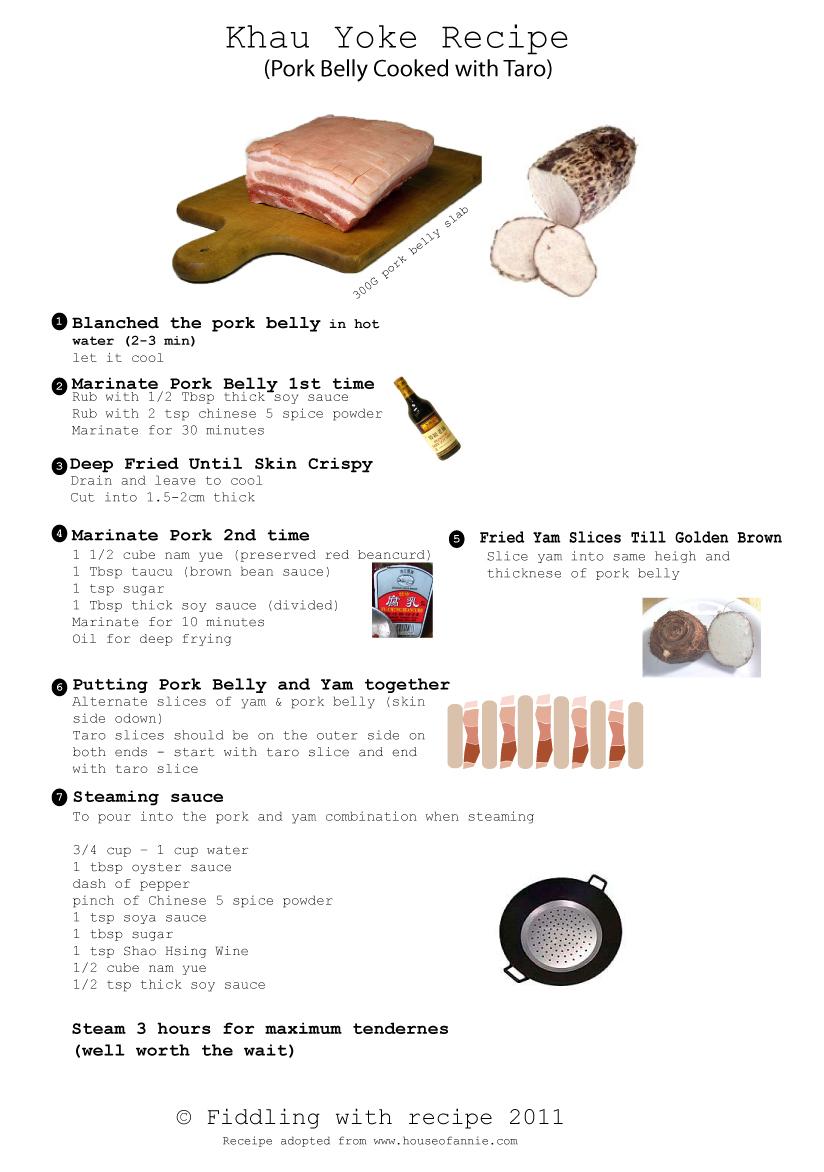
      Khau Yoke Recipe (Pork Belly Cooked with Taro) 客家芋头扣肉


      If you like this dish and have not try making it before, give it a try!  It is actually easier than you think as I found out from my first ever attempt.

      After steaming for 3 hours, my end product is a melt in your mouth pork with creamy yam.  Having say that, I could have made it with more gravy/source and maybe add a few more spices for a richer taste.  But overall, I have no complain and were happy with it.

      The basic steps in cooking Hakka Khau Yoke (Pork Belly Cooked with Taro) in sequence are:
      1. Blanching (2-3 minutes)
      2. Marinating (30 minutes)
      3. Frying (15 min, give or take)
      4. Making steaming sauce (10 minutes)
      5. Sandwiching yam and pork (10 minutes)
      6. Steaming ( ideally 3 hours - you don't have to do anything)
      Don't be fool by the long hours needed, the active kitchen time is around 20-30 minutes. You are going to have a lot of idle time during marinating and steaming.

      Ingredients are simple and you don't have to buy any special, hard to find spices.  Basically you need the following (serves 3-4 person)

      Core ingredients
      1. 300g strip of Pork belly (五花肉或三层肉) ideally about 5-7 cm in width which will then cut cross section to slices. 
      2. Yam (taro) - medium size
      3. Nam Yue (preserved red beancurd) - 1 1/2 cub
      For Marinating Pork Belly
      Coat/rub the pork belly with the following
      • Dark soy sauce - 1/2-1 tbs
      • Chinese 5 spices - 2 tsp
      Making steaming sauce
      This will be the sauce to pour over the pork belly and yam for steaming

      • 3/4 cup – 1 cup water (add more water if you prefer more sauce)
      • 1 tbsp oyster sauce
      • dash of pepper
      • pinch of Chinese 5 spice powder
      • 1 tsp soya sauce
      • 1 tbsp sugar
      • 1 tsp Shao Hsing Wine
      • 1/2 cube nam yue 
      • 1/2 tsp thick soy sauce
      Things I learned
      • The steaming sauce is very important, it enhanced the overall package of yam and the pork belly, and yes, it make a super tasting gravy with white rice. May be next time I would consider adding others flavourings agents like five spice powder, pepper, onion, ginger, oyster sauce, fish sauce , sesame oil, shao hsing wine (I do not use this since this is my 1st time)
      • There was another version that fried all the flavoring ingredients and  coat them on the pork belly (after deep frying) and yam before steaming.  I believe this method may produce a stronger tasting dish!
      • Very useful tips on how to handle the yam, the pork belly and the selection of dish for steaming is here.

      Marinate Pork Belly after blanching for 30 minutes
      Slice and fried yam into sizes
      to match with the pork belly

      Slicing pork belly after deep frying. 
      Don't worry if still uncooked for now


      Arranging yam and pork belly for steaming
      (3 hours for maximum tenderness)